Earn to Die 2
- 4.5
- Rating
- 100.00M
- Installs
- Free
- Price

 Analysis by App-foxy
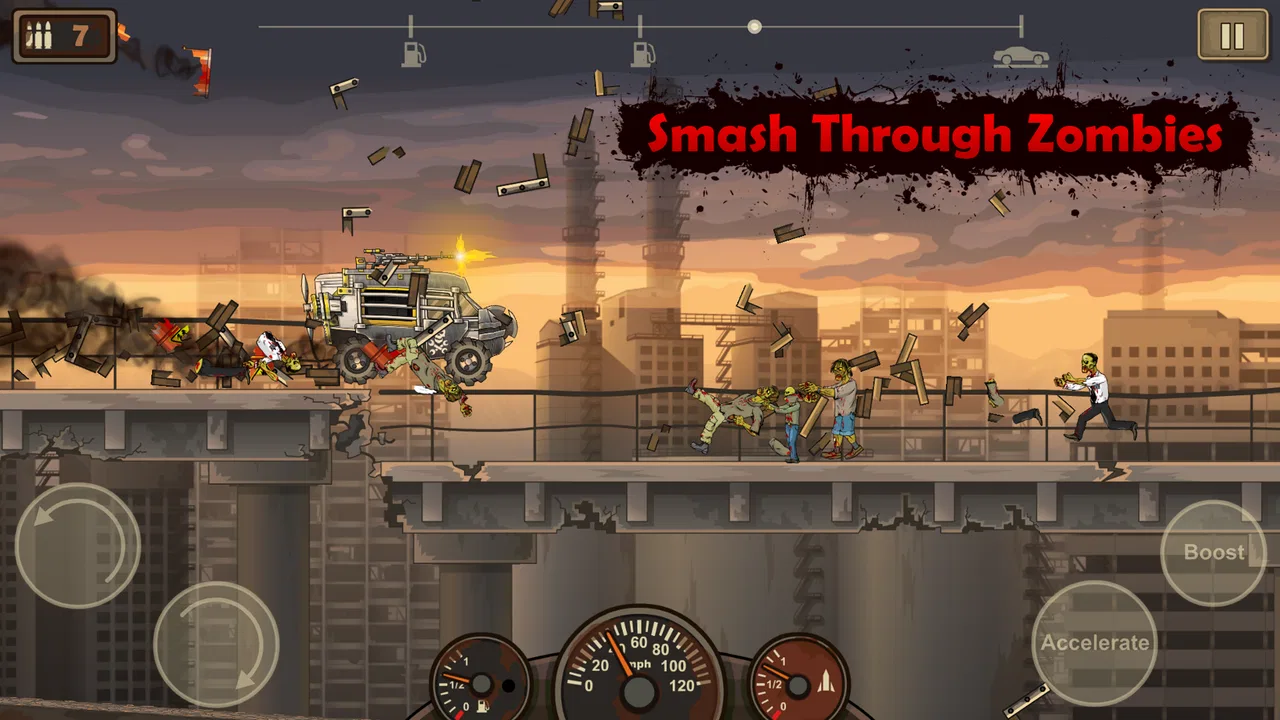
Earn to Die 2 is the kind of racing game I can recommend when you want something quick to understand but still satisfying after several short sessions. I drive through a zombie-filled world, keep the vehicle moving over broken terrain, and improve my chances by making sensible upgrades rather than relying only on fast reactions. It is built by Not Doppler and sits in the racing category, although its side-scrolling format makes it feel quite different from a traditional circuit racer.
The basic idea is easy to grasp: get as far as possible, earn enough progress to improve the car, and try again. What makes the loop work is the feeling that every failed run teaches me something. A hill that stopped me before may become manageable after an engine improvement, while a rough landing may show me that I need better control rather than more speed. That steady sense of progress is the main reason the game has remained appealing to such a large audience.
What to expect when you start
The first thing to understand is that this is not a realistic driving simulator. The car behaves more like a compact physics puzzle with racing controls. I need to balance acceleration, braking, and the vehicle’s angle while crossing obstacles. A good run is not always the fastest one. Sometimes easing off the throttle before a jump gives me a cleaner landing and saves the vehicle from losing valuable momentum.
You May Also Like

 Blood Strike: 2.5 Anniversary
Blood Strike’s Loadouts Turn Every Drop Into a Tactical Gamble
A close look at Blood Strike’s custom loadouts: how fast access to signature weapons reshapes its battle royale rhythm, rewards preparation, and narrows the gap between fights.

 Pandora - Music & Podcasts
Pandora’s Music Is Easy to Start, but Harder to Recover
Pandora’s strength is its low-effort path from a seed to a station. Its weak spot is how much confidence it asks you to place in connection, setup, and quiet recovery.

 8 Ball Pool
 Is Built on Rivalries, Rematches, and Routine
A close look at the rivalries, rematches, shared routines, and unanswered safety questions that turn a quick pool match into a persistent mobile community.

 Samsung Music
’s Quiet Strength Is Playing What You Already Own
Its reach comes less from spectacle than from dependable access to a personal library. That simplicity is both the app’s strongest retention engine and its ceiling.

 AccuWeather: Weather Radar
AccuWeather Review: A Quick, Clear Forecast for Everyday Decisions
For everyday plans, the best forecast is the one you can understand quickly. AccuWeather makes rain timing, radar, and local conditions easy to act on, with a few trade-offs.

 Hill Climb Racing
Why Hill Climb Racing Still Turns Crashes Into One More Run
A tiny car, a bumpy hill and one more upgrade: Hill Climb Racing keeps resurfacing because its simple chaos makes every near-miss feel personal.
More From Our News Desk
View All News


The zombie-apocalypse setting gives the races a clear purpose, but the strongest part of the experience is the road itself. It constantly asks me to react to slopes, gaps, wreckage, and awkward landings. The challenge comes from combining timing with gradual improvement. If I simply hold the accelerator and hope for the best, I usually waste a run. If I watch how the car moves and adjust early, the same route becomes much more manageable.
That makes this a good fit for players who enjoy compact attempts rather than long races. I can play while waiting for an appointment, then stop without feeling that I abandoned a complicated campaign. At the same time, it has enough upgrade-driven progression to keep me returning when I want to overcome a particular obstacle.
The game is free to play, with optional in-app purchases ranging from $0.99 to $5.99 per item. I would approach those purchases carefully. The central appeal comes from learning the vehicle and building progress through repeated runs, so spending should feel optional rather than necessary for a first-time player. The content rating is Teen, which is worth keeping in mind for families because the theme involves zombies and action rather than gentle cartoon racing.
Its audience size is easy to understand: it has passed 100 million installs, carries an average rating of 4.5 from around 2 million ratings, and has about 41 thousand written reviews. Those figures do not replace personal experience, but they do suggest that the unusual combination of driving, physics, and upgrade progression has reached well beyond a small niche.
The first few minutes are about learning control
When I begin, I do not try to treat the opening run as a test of speed. I use it to learn how quickly the car responds and how much air control I have after leaving a slope. The important habit is to look ahead at the shape of the road instead of staring only at the vehicle. A short pause on the accelerator can be more useful than constant full power, especially when the next landing is uneven.
One practical tip is to notice where a failed attempt actually went wrong. If the car reaches an obstacle but loses all momentum, an upgrade may be the answer. If it reaches the obstacle with plenty of speed but flips on the landing, control is the issue. This distinction prevents me from spending progress on the wrong improvement and makes each retry more purposeful.
I also recommend resisting the urge to restart immediately after a minor mistake. A run that looks imperfect may still teach me whether the vehicle can recover from a bad angle or whether a certain section is worth approaching more slowly. That information is useful, particularly when I return to the same route after upgrading.
Setting up a first meaningful run
There is no complicated account-building ritual that defines the opening experience. I can get into the driving quickly, which is one of the game’s strengths. For a first session, I would choose a quiet moment, play through several attempts, and focus on recognizing the relationship between speed and stability. The game makes more sense once I stop viewing every run as a race against an invisible stopwatch and start treating it as a small experiment.
A sensible first-session routine is simple. I make one run without worrying about distance, make a second while changing how I handle jumps, and then compare the result. On the next attempt, I apply one adjustment rather than changing everything at once. This approach makes it easier to identify what helped. It also reduces the frustration that can come from repeatedly pressing the same controls and expecting a different outcome.
Players who are used to tilt-based racing may need a short adjustment period if they expect the car to behave like a standard mobile racer. Here, the vehicle’s balance matters as much as its direction. I find that deliberate inputs are more reliable than frantic ones. When the road becomes chaotic, a calm correction usually works better than repeatedly switching between acceleration and braking.
How to reach the first satisfying success
The first meaningful success is not simply surviving a few seconds. For me, it arrives when I clear a section that previously forced a restart by changing my approach instead of just trying again. That might mean carrying more speed into a climb, lifting off before a jump, or keeping the car level during a landing. The game rewards this kind of small discovery because progress feels connected to both the vehicle and the player.
To reach that point, I suggest using the first upgrade as a response to a repeated problem. Do not choose an improvement merely because it sounds powerful. Watch the last few attempts and ask what stopped you most often. If the car struggles to climb, more power may help. If it reaches the top but becomes difficult to control, the better choice may be the improvement that makes handling more comfortable. The exact decision depends on how you drive, which is part of the game’s appeal.
Another useful habit is to treat fuel and momentum as resources during a run rather than pressing forward without a plan. Maintaining movement is important, but unnecessary wheelspin or a poor landing can waste the advantage gained from a strong start. I get better results when I think one obstacle ahead. Preparing early gives me more room to correct the car than reacting at the last possible moment.
When a run finally goes well, I can usually explain why. That is a stronger reward than a random lucky attempt. The game’s progression works best when I connect a new upgrade with a new driving technique. If I only wait for the car to become powerful enough, the later sections can feel like a grind. If I learn alongside the vehicle, the difficulty feels more fair.
Common confusion during play
New players may assume that maximum acceleration is always the correct answer because the game is presented as a race. In practice, speed without balance can be harmful. A car that reaches a jump too quickly may land upside down or lose the momentum needed for the next incline. I often get farther by varying the throttle and preparing for the landing than by holding it down continuously.
It is also easy to mistake a control problem for a progression problem. When a vehicle repeatedly flips, buying an upgrade may not solve the real issue. The better first step is to change the timing of the input. I try a gentler approach, observe the car’s angle in the air, and avoid making several corrections at once. Once I know the section is being handled correctly, an upgrade becomes more meaningful.
Another point of confusion is the difference between a failed run and a wasted run. Even a short attempt can reveal how an obstacle behaves, how much momentum a slope gives back, or whether a particular landing is safe. I find the game less frustrating when I use those attempts as information. The repetition is intentional, but it works only if I pay attention to what changes between runs.
The free-to-play structure may also invite questions about whether purchases are necessary. My experience is that the core loop is enjoyable without treating the shop as the main path forward. I would first learn the controls, use the progress earned through play, and decide later whether an optional purchase genuinely improves my experience. Anyone who dislikes repeated attempts or any form of optional spending should know that the game’s design is built around retrying and improving.
Where it fits among racing games
Compared with a conventional mobile racer, this game offers less emphasis on licensed cars, realistic tracks, or direct competition against other drivers. I do not choose it when I want a polished circuit race with overtaking and lap strategy. I choose it when I want the road itself to be the opponent. The side-on view also makes the action easier to read than a busy three-dimensional race, especially during short sessions.
It differs from endless runners because the vehicle’s development matters. An endless runner usually asks me to survive as long as possible with a fixed set of abilities. Here, repeated attempts can change what the car is capable of, while my own understanding of the terrain improves at the same time. That combination gives failures a clearer purpose.
It is also distinct from a pure physics sandbox. The game has direction and progression rather than asking me to experiment without a goal. I always have a reason to attempt the route again: reach farther, handle a difficult section, or make better use of the vehicle. Players who enjoy games where every retry has a visible objective will probably appreciate that structure.
The trade-off is variety. Someone looking for many vehicle classes, deep customization, or a broad multiplayer scene may find the experience narrower than a larger racing package. Its strength is focus. The controls, obstacles, and upgrades all serve the same compact loop, and that makes it easy to pick up. It also means the game may not satisfy someone who needs constant changes of mode.
Useful habits for longer progress
After the first successful section, I stop spending every improvement on the same attribute. A balanced vehicle is often more useful than one that is excellent in one area but awkward everywhere else. If extra power helps me climb but causes rough landings, I may need to support that strength with better control. The best setup is the one that matches the obstacle I am actually failing on, not the one that looks strongest in isolation.
I also recommend playing with a consistent rhythm. A few focused attempts are more productive than a long session where every failure blends into the next. When I notice that I am repeating the same mistake without thinking, I take a break and return later. Because the routes rely on timing, tired reactions can make a manageable section seem unfair.
For an everyday scenario, this is ideal during a short commute or a ten-minute break, provided I am not driving at the time. I can complete several attempts, remember the obstacle that stopped me, and return later with a clear goal. The game does not require me to reconstruct a large story or remember a complex control system after a pause. That accessibility is one of its most practical strengths.
On a larger screen, the action may feel easier to inspect, but the game’s short-session design suits a phone particularly well. I would still make sure the controls feel comfortable in the way I normally hold the device. Small changes in grip can affect how confidently I react, especially when a landing requires a quick correction.
Who should play and who should skip it
I would recommend it to anyone who likes arcade racing with a physical feel, repeated attempts, and upgrades that solve specific problems. It is especially approachable for a first-time player because the objective is obvious and the early lessons arrive through play rather than a long explanation. Fans of zombie settings may enjoy the atmosphere, but the driving challenge is what keeps me engaged.
I would be more cautious recommending it to players who want realistic handling or head-to-head racing. Those players may be happier with a conventional track racer. I would also skip it if repeated retries feel irritating rather than motivating. The game expects me to accept failure as part of the route, and that design will not suit everyone.
Families should consider the Teen content rating before installing it for younger players. The presentation is centered on surviving a zombie apocalypse, so it is not simply a harmless car game despite its accessible controls. Adults who prefer calmer puzzle experiences may also find the theme and repeated crashes less appealing.
Device and purchase considerations
The current version is 1.4.58, and the game requires Android 6.0 or later. That makes it available to many Android users, though anyone with an older phone should check compatibility before planning a session. I would also leave some room for the game to run comfortably and avoid judging the experience during a moment when the device is already struggling with other demanding tasks.
The free entry point is helpful because I can test the driving loop before deciding whether it belongs on my phone. Optional items cost between $0.99 and $5.99 each, so I would use purchase controls carefully if the device is shared with children. My advice is to play far enough to understand whether the retry-and-upgrade cycle is enjoyable on its own. If it is not, a purchase will not fix that basic mismatch.
Not Doppler has kept the concept direct: drive, learn, improve, and try again. That simplicity is not a weakness at the beginning. It gives a new player a clear route from installation to the first real breakthrough. The limitations become more visible only if I expect a full-scale racing simulator or a constantly expanding collection of modes.
My final recommendation
The best way to approach Earn to Die 2 is as a driving challenge built from small lessons, not as a race that rewards constant full speed. Once I watch the terrain, choose upgrades around actual problems, and treat failed attempts as useful feedback, the progression becomes much more satisfying. The zombie setting gives the runs personality, but the careful balance between momentum and control is what makes the game memorable.
After installing it, I would spend the first session learning how the car lands, then focus on one obstacle that repeatedly stops me. I would make one upgrade, change one driving habit, and see whether the result improves. That process gives a first-time player a concrete path forward without requiring expert knowledge or a large time commitment.
For me, this is a strong free racing game when I want short, focused sessions and a clear reason to retry. It is not the right choice for realistic racing, multiplayer competition, or deep vehicle simulation, but it succeeds on its own terms. With its 4.5 average and more than 100 million installs, its popularity is understandable: the controls are approachable, the failures are readable, and every hard-earned improvement makes the next run feel possible.
FAQs for Earn to Die 2
01What is the main objective of Earn to Die 2?
Earn to Die 2 challenges players to survive a zombie apocalypse by driving through hordes of undead. The goal is to reach the evacuation ship on the other side of the country. Players must upgrade their vehicles and equipment to make their way through increasingly difficult levels filled with obstacles and zombies.
02How do vehicle upgrades work in Earn to Die 2?
In Earn to Die 2, players earn money by driving through zombie-infested terrains. This money can be used to upgrade various parts of their vehicles, including the engine, wheels, fuel tank, and weapons. These upgrades are crucial to progress through tougher levels as they enhance the vehicle's performance and durability.
03Is Earn to Die 2 free to play?
Earn to Die 2 is available for free on both Android and iOS platforms. However, it may include in-app purchases that offer players the option to buy additional in-game currency or remove ads, enhancing the overall gaming experience. Players can choose whether or not to spend money on these extras.
04What are the controls like in Earn to Die 2?
Earn to Die 2 features intuitive controls that are easy to learn for new players. The game typically uses simple touch controls where players can accelerate, brake, and tilt their vehicles. This straightforward control scheme allows players to focus on strategic upgrades and navigating through the challenging terrains.
05Does Earn to Die 2 require an internet connection?
Earn to Die 2 can be played offline, making it convenient for players who do not have constant internet access. However, an internet connection may be required for features like in-app purchases or to download updates. The offline capability ensures players can enjoy the game anytime and anywhere.
Pros
- Engaging storyline with new levels
- Improved vehicle customization options
- Challenging obstacles enhance gameplay
- Vibrant graphics with detailed environments
- Offline play mode available
Cons
- In-app purchases can be costly
- Repetitive gameplay after a while
- Limited vehicle variety
- Ads can interrupt gameplay
- Long load times between levels

Earn to Die 2
Gallery